


GalCiv IV Dev Journal #118: Oligarchies in Federations & Empires
https://store.steampowered.com/news/app/1357210/view/673995578702561399 GalCiv4 Forums
How might a hyper-capitalistic civilization develop in the future? That’s the question we wanted to play out and the upcoming expansion pack for Galactic Civilizations IV, Federations & Empires, will answer it. The Oligarchy form of government results in a very different set of gameplay mechanics from the other governments and today we’re going to dive into it.
The Background
Here are some early concepts we played with how to manage these that I thought you might find interesting:
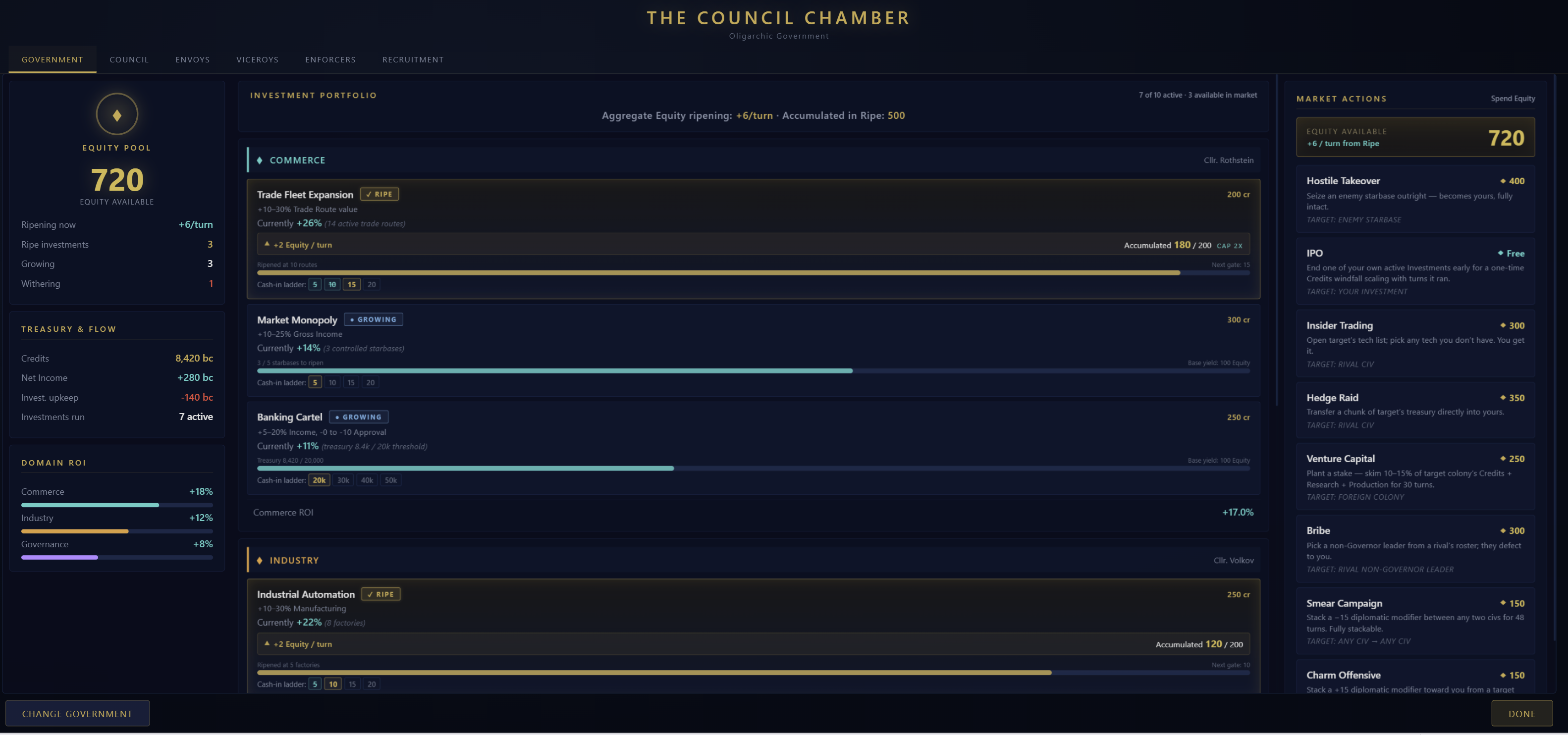
You can play around with the interactive mockup here: GC4 Government: Oligarchy
This eventually became this:

And even that isn’t what it will fully look like. So let’s dive in!
Holdings and the Prospector
The Oligarchy's first new tool is the Prospector, a special ship you can only build while running an Oligarchy government. It works like a Colony ship in that you send it somewhere and it gets consumed on arrival, but what it does when it arrives is completely different. A Prospector can land on any unowned planet: Class 0 dead worlds, barren rocks, gas giants. Worlds that no other government would bother with. When it arrives, that world becomes a Holding. Holdings are not colonies. There's no build queue, no governor, no citizens, no production. You don't manage them. What a Holding does is sit in your portfolio and contribute Collateral (the Oligarchy's unique resource) equal to that planet's quality rating plus one. A Class 2 world contributes 3 Collateral. A Class 0 dead rock contributes 1. Not much on its own, but the Oligarchy doesn't think in terms of individual acquisitions. Holdings can be conquered and destroyed just like regular worlds. Losing one hurts, and we'll get to why that matters. The key thing to understand up front: you're claiming territory nobody else wants, turning it into a financial asset, and the rest of your empire never has to think about it. That's the loop.
Collateral
Collateral is not a resource you earn per turn. It's a stock: the sum of every Holding in your empire.
If you have eight Holdings averaging Planet Quality 2, you're sitting on roughly 24 Collateral. Claim another world and the pool goes up immediately. Lose one in a war and it drops immediately.
There's one exception: the Chairman of the Board, one of your four Council positions, provides a bit of Collateral assigned leader's Social stat. It's a starting point, not the foundation. Holdings are the foundation.
Collateral doesn't get spent. It gets tied up. When you make an Investment, some amount of Collateral is committed to that Investment for as long as it stays in your portfolio. Your available Collateral is whatever's left over.
Your money isn't going anywhere. It's locked up working for you.
The Portfolio
The Oligarchy's central action is buying Investments.
There are five at launch that you get right away, others are unlocked through techs, events, etc.
- Stellar Logistics Conglomerate: your entry point, matures in 5 turns.
- Pan-Galactic Banking Syndicate: mid-game financial anchor, 12 turns to mature.
- Xeno-Resource Holdings: a resource cartel, 15 turns.
- Helix Pharmaceutical Cartel: social disruption play, 18 turns.
- AstroDyne Defense Trust: a defense contractor, 20 turns.
When you buy an Investment, the Collateral cost is tied up in your portfolio and a maturity timer starts counting down. Once the timer hits zero, the Investment is matured, and that matured state is what unlocks your access to the Oligarchy's exclusive Executive Orders.
The Investment itself stays in your portfolio indefinitely. Playing an Executive Order doesn't consume it. The Investment just needs to exist in a matured state, and you can keep using the Order it unlocks for as long as you hold it. Sell the Investment later and the Order disappears, but you do get 1.25 times your original Collateral cost back, paid out in Credits.
There's a natural tension here. Selling Investments turns long-term strategic commitments into short-term cash. But the purchase cost scales up every time you buy an Investment. It's a monotonic counter and selling doesn't reset it. The player who churns their portfolio chasing Credits pays more and more for every new Investment. The player who holds everything has a deep deck of plays nobody else in the galaxy can access. Neither approach is strictly correct, and that's exactly what we wanted.
Executive Orders
Once an Investment matures, you unlock an Executive Order no other civilization can use. These aren't passive bonuses. Each one is designed to make something happen.
Dumping Rights (from Stellar Logistics): Flood a rival civilization's economy with cheap goods for 20 turns. Their trade route value drops 75% civ-wide, and you earn Credits equal to 10% of what they're losing every turn. You corner their market and profit from it at the same time.
Leveraged Buyout (from the Banking Syndicate): Target one of your own Corporation Links. Convert that soft 5% bidirectional exchange into 15% of the destination world's output flowing entirely to you, permanently. It costs you one permanent Corp Link slot, and it costs the foreign world their share of the exchange.
Resource Embargo (from Xeno-Resource Holdings): Block a rival's access to one of their active strategic resources for 15 turns. Any ship they try to build requiring that resource costs 25% more during that window. Particularly useful during a war.
Private Navy (from AstroDyne Defense Trust): Three mid-tier warships show up at your homeworld, mercenaries, maintenance-free, yours to command. The battle log will show them as hired ships.
Plague Scare (from the Pharmaceutical Cartel): Engineered panic. Pick a rival and every one of their colonies loses 25 Approval for 20 turns.
Corporations
Separate from Holdings and Investments, the Oligarchy runs three Corporations:
- A Research Combine
- A Cultural Syndicate (Influence)
- A Manufacturing Trust
Each civilization has their own names for their corporations.
Each Corporation lets you build a special Freighter-pattern ship from your shipyards. You send it to a foreign world. It's consumed on arrival and establishes a permanent Corporation Link between your origin world and that destination.
Every turn, each active Corp Link transfers 5% of each world's relevant resource bidirectionally. Send your Research Corp Ship from your 200 Research/turn homeworld to a foreign world producing 80 Research: your homeworld picks up +4 Research/turn and their world picks up +10. They benefit from the exchange too, which is part of why the design doesn't require any foreign civ approval mechanic.
Your Corp Link cap runs parallel to your Trade License cap. Same maximum number with its own pool. Corp Links and regular Trade Routes don't compete for the same slots. Get more Trade Licenses through tech and both your Trade Routes and your Corp Link capacity increase.
Corp Links pause automatically during wars with the destination civ and resume when peace is declared. The only permanent break is if you conquer the destination world yourself. At that point the world is yours, and the Link is gone.
The Council
The Oligarchy has four Council positions, each bending a different part of the system.
Chairman of the Board speeds up Investment maturity. New Investments purchased while this seat is filled take 20% less time to mature. The Chairman also generates a small per-turn Collateral trickle based on the assigned leader's Social stat.
Chief Investment Officer raises your Investment sell-back from 1.25x to 1.50x while occupied. The Sell button is worth more.
Director of Acquisitions upgrades every Holding in your empire from contributing PlanetQuality+1 Collateral to PlanetQuality+2. Fill this seat and every dead rock you've claimed is worth more. Also speeds up Prospector construction by 25%.
Director of External Affairs adds one to your Corp Link cap and gives your Corp Links a 5-turn grace period before they pause when you declare war. Five turns to prepare for the economic disruption of a conflict.
We may end up adding more as we play test.
When Things Go Wrong
If a rival conquers one of your Holdings or a planet-killer event destroys it, your Collateral pool drops. If that drop puts you below the amount currently tied up across your Investments, your Investment maturity timers pause.
Nothing auto-liquidates and you don’t lose investments. BUT you are just frozen until you recover: claim new worlds with Prospectors, sell Investments to free up tied-up Collateral, or take back a lost Holding with your fleet. Executive Orders you'd already unlocked through matured Investments still work. The pause is on the clock and not on your existing matured portfolio. We didn’t want to make this super painful.
The Chamber of Commerce
All of this lives in a new government screen called the Chamber of Commerce. Holdings, Portfolio, Corporations, and Council each get their own tab. Your Collateral displays as both a total pool and an available amount, with the tied-up portion shown explicitly so you always know how close to the edge you're running.
The Oligarchy isn't trying to have the most worlds. For the civilization that wants to play tall, this might be the way to go. You could have a single home world and no colonies. Just holdings.
Let us know what you think!