AnthonySalter AnthonySalter

Elemental: Citybuilding

Elemental: Citybuilding

What we're shooting for and why.

Hi!  I'm Viridian, also known as Anthony Salter, and I just finished a major revamp of the citybuilding system.  I'd like to talk today about our design goals for citybuilding and how the system currently works.

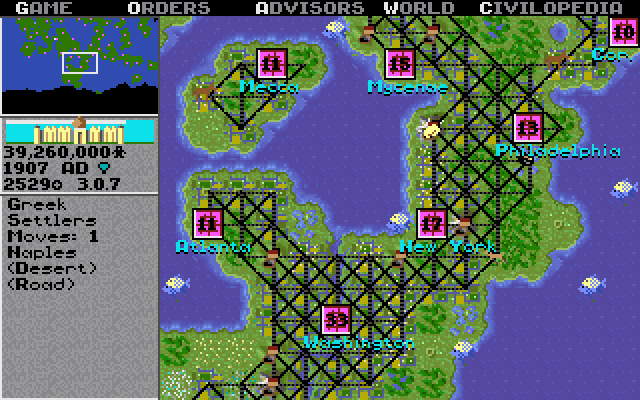
First, let's look at how our major inspirations, Civilization and Master of Magic, handled cities.  In both games, cities were fairly abstract.  They consisted of a single icon on the map and a screen full of sprites and numbers.
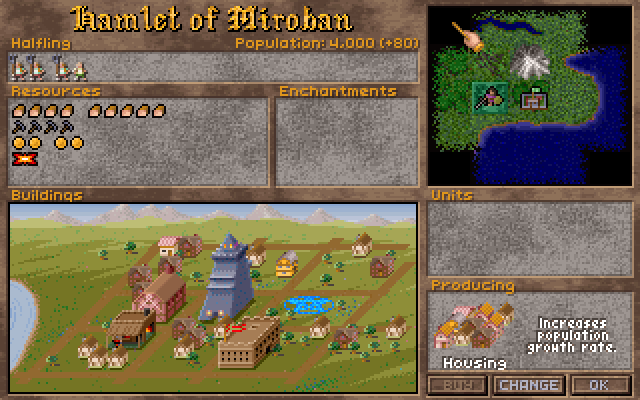


And you would end up with dozens of the things as the game progressed; to the point where you'd probably end up ignoring some because they were too small or unproductive to help you win the game.  (Didn't prevent them from falling into civil disorder and bringing your whole empire to a grinding halt...grr...)
 

As strategy games developed, a genre of incredibly detailed citybuilding games emerged, including the Caesar series, the Settlers series, and the Anno series.
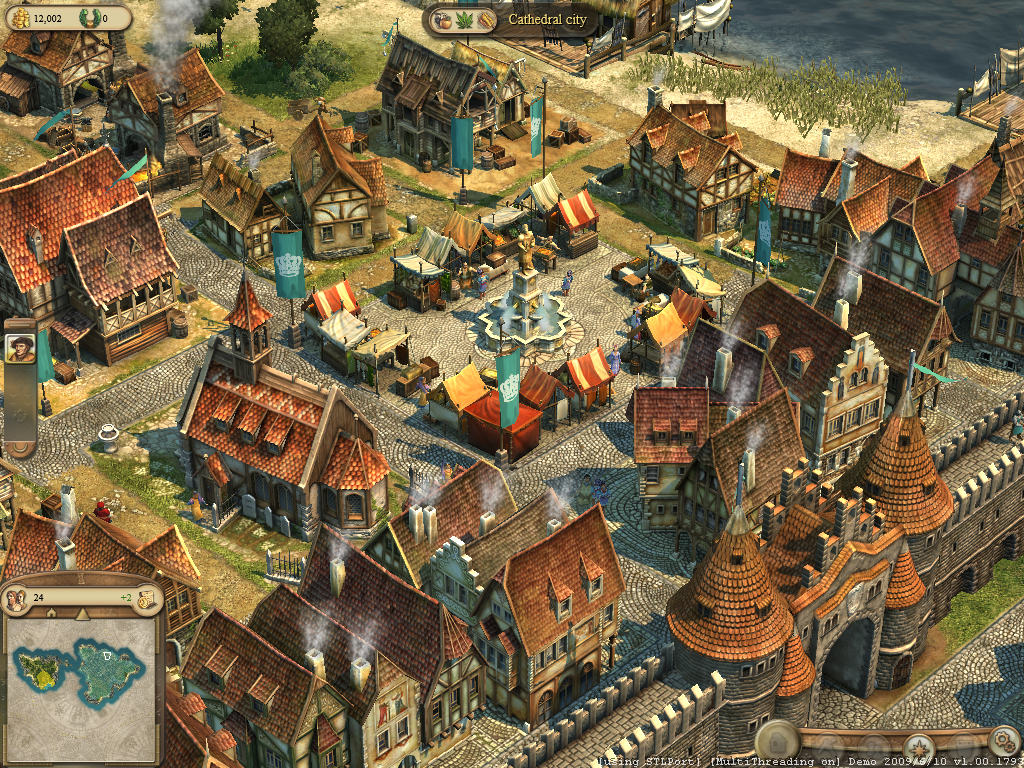


In these games, everything is simulated practically down to the atomic level.  These are the kinds of games where you need to mine ore to make tools to cut down trees to gather lumber to take to the sawmill to make planks to build new buildings.

Now, there's no doubt this can be fun.  I've enjoyed both the Settlers and the Anno series of games myself.  The only problem is that citybuilding, while important, isn't the only thing you do in Elemental, and thus we can't allow it to dominate the game the way it does in Anno-style games.  (I can hear certain people weeping on the forums already but it's true.)  So what we've tried to do is create a happy medium.

I've spent all this time telling you how citybuilding won't work; it might be a good idea to tell you how it will.

What exactly did we want when we set out to create our citybuilding system?

Well, first, we didn't want city spam.  Thus, we created a system where building a smaller number of larger, older cities is rewarded.

As you probably know, Sovereigns can create cities, thus creating a town hub.  There are five levels a hub can go through - they start as outposts, then upgrade to hamlets, villages, towns, and cities.  At each upgrade point you'll get eight new tiles to build improvements on - and your city will be able to support more efficient improvements that it couldn't before.

Another feature of cities is that they are (mostly) auto-upgrading.  If you expand your city to a village and you have the Housing technology researched, then all your huts will upgrade to houses - instantly, and for free.  Your city needs to be at the proper level and you must have the technology researched in order for this to happen.  Again, I can hear the cries of some forum-goers who think that this will negatively impact the game, but we're facing facts here.  Ninety percent of the time when we get a new housing tech we simply demolish our old houses and build new ones right where the old ones were.  Because of the hard forty-tile limit you can't just throw more out there - non-optimal improvements will literally be a detriment to your city.

Indeed, crafting a good city is going to be a continual series of trade-offs rather than a forever-growing list of improvements.  And as the city grows and the game progresses, you will find yourself continually repurposing your cities rather than building new ones.
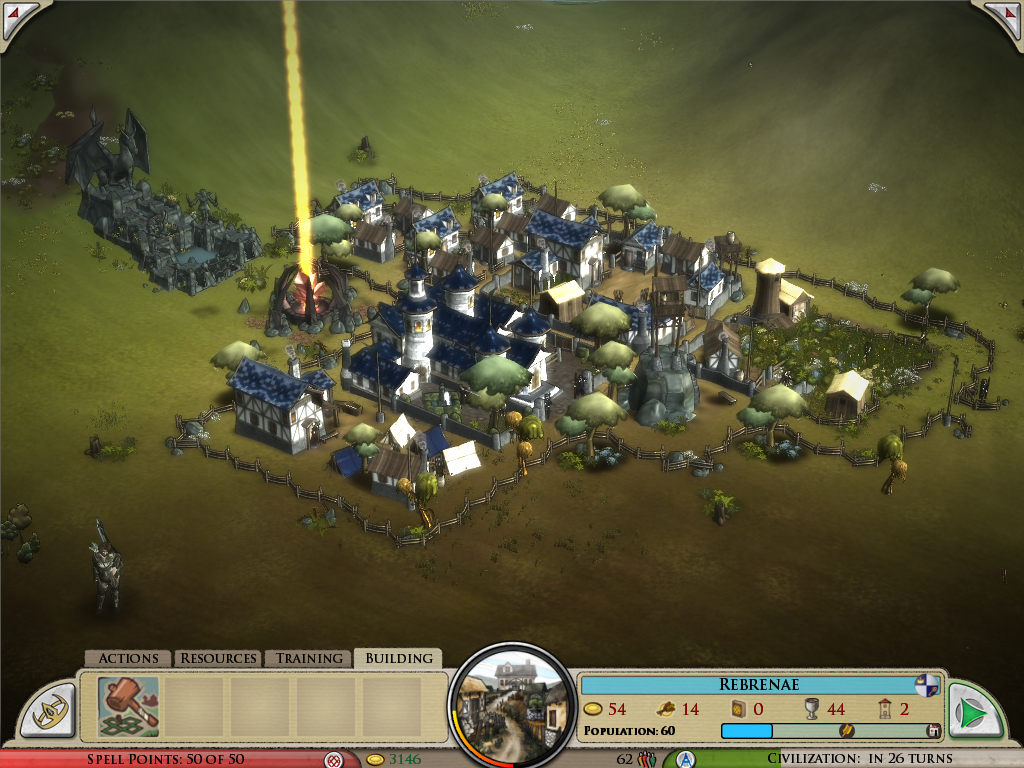
An early city in Elemental.


Our goal is to strike a balance, so that we aren't overwhelming the player with city management, but we still provide a robust enough experience that you don't just think of your city as numbers and sprites.  When someone attacks your city and your little people start running around screaming, we want you thinking, "Hey!  Stop picking on them!  How 'bout a little FIRE, Scarecrow?!"


EDIT:  I originally stated that Sovereigns needed to expend essence to create cities.  This is incorrect; they expend essence to bring the land back to life so the city can be built.  I have fixed the error in the article.

494,749 views 157 replies +1 Loading…
Reply #126 Top

Quoting leeboy26, reply 111
My one hope is that there is an option that allows you to change the growth/building turn speeds of settlements in bigger games. For some reason games developers are very unimaginative when it comes to difficulty options. I'd prefer more than just 'easy' 'medium' and 'hard', give me custom options, damnit! (SoaSE was on the right track). I want to play a huge map that takes me real-time hours to build cities up, it helps emotional investment as well.
End of leeboy26's quote

Couldn't agree more. Massive Epic Games FTW!!!

Reply #127 Top

The AI at deity Civ IV does not 'cheat', it just have very more loose rules to play with than the player has. It pays next to no upkeep for having lots and lots of cities, it pays less hammers for units, it starts with a lot of bonus techs where the player has only two, etc.
End of quote

This is also known as cheating. Sure, it doesn't type in porntipsguzzardo (points to whoever gets it), maybe it doesn't have unlimited LoS, but the very fact that it pays less for everything and starts with massive bonuses is cheating. Rather than rely on the AI using good strategy and tactics to out-play the human player, it relies on endowing the AI with bonuses of all sorts to compensate for its lacking performance in those areas.

You could call it a handicap, but it really is just cheating. The AI is not playing by the same rules you are in an attempt to level the playing field (because you are a better strategist) or to provide a masochistic experience to those who enjoy such things :P

For example, Stardock prides itself on its ability to program good AIs without resorting to making them cheat. Take GC2 for example - the AI through the Tough difficulty setting plays by exactly the same rules as the player does, and plays quite well. Bump it up above Tough, though, and it starts to bend the rules - it pays less, builds faster, and so on. That is what "cheating AI" means. 

Reply #128 Top

Well you and I have basically different perspectives on cheating. You make it sound like starting with an advantage is cheating while in go-tournaments lower ranked players start with extra tokens on the board to make up for lesser skill, and in golf solid players and rookies have different handicaps since the rookies get a discount on the number of hits they have to count, therefore giving the rookies a chance against better players.

This is evening the playing field in my eyes, whereas cheating would be granting the AI the ability to create units out of thin air, being able to create 2 units in one single city in one turn, getting techs for free later in the game just because the AI desperately needs it, etc. This is something the AI does not do, they still play by the rules, just the rules are far far less harsh for them as they are for the player.

Reply #129 Top

When the AI is playing the game by a different set of rules then everybody else, the AI is cheating. That's the way the term is always used when it comes to AI, since the AI can't cheat by using things like hacks. You're describing the same thing in something like a tournamnet, where it's just called a handicap instead. Same thing, different terminology.

The test of an AI is how challenging it can be while playing under the same rules as the player.

Reply #130 Top

Well in that case the AI does cheat. In that case I also think cheating is not a bad thing since the players will figure out what the AI is going for and adapt their plans while the AI has no such ability. The AI needs some sort of trick to keep up with the player and to make up for the lack of 'vision'that a player has.

Reply #131 Top

When the AI is good to begin with, cheating helps it be better, yes. But a bad AI given cheating help is still bad.

AoW2 suffered from that. The AI wasn't very smart about how it would do things like forming up stacks. In the early game, its cheating advantage and the general fact that it started off with more terrain then the player made things challenging. You had to compete against superior forces to gain ground.

But the AI's fatal flaw is that it liked to use mixed stacks. Some high tier, some low tier units combined. Anybody good at AoW2 knows that due to the stack limit, top tier units are ALWAYS better for offense once you can build them. A hero and 7 top tier units will destroy any stack that isn't comprised the same way, and with the proper use of spells will destroy several weaker stacks at the same time.

So the player churns out one stack that the AI simply cannot defeat despite it's advantages, because the AI is simply playing the game wrong. All the cheating in the world (and at the highest difficulties it cheats substantially) and all th extra units it gets can't make up for its inability to make a decent stack.

Eventually you break the AI's main force, and then it retreats into defensive mode at every city it owns, stops being able to attack you, and you enter the mopup phase.

A good AI on the other hand would need less cheating, because it's better at using the advantages it has.

Reply #132 Top

3. I would like to see automatic upgrades have different options for their resolution. Example: Your House+1 gets upgraded automatically at no cost once the tech (and/or whatever other prereqs need be met) gets available IF you have also invested in Quick Building (or whatever you want to call something, be it a Governor or be it a Tech, which gets you that bonus), otherwise, they upgrade automatically AT COST X (cost might be reduced by other factors), and they take Y turns to upgrade depending on how good your Governor and/or synergetic techs and/or special buildings also present might be (example: advanced forges with a very good Governor or however Boogie called them gets you free immediate better swordsmen once prereqs are met, advanced carpentry with very good Governor and special Groovy Woodshack building gets you free immediate House+1s when prereqs are met, otherwise, costs time and money). I just want there to be DIFFERENT WAYS for things to work out depending on what STYLE of Builder you are. Note that ALL of the options I list here require no micromanagement, they merely make the automatic upgrades better/quicker/cheaper.
End of quote


I think taking any time to upgrade improvements is going to bog down gameplay. This is a time of powerful wizardry and fanastic ability. Why wouldn't it only take a month or week to build a larger house? It only takes a week at most to do it in present day Washington state, and don't even have giants.

I like the simplicity of the current, and probably permanent, system we are using. I takes a type of management out of the game which is important for multiplayer, the main reason this game is better than gal civ, as opposed to a prequel.


x_x  x_x x_x x_x              :borg:


Reply #133 Top

Quoting seanw3, reply 132

////3. I would like to see automatic upgrades have different options for their resolution. Example: Your House+1 gets upgraded automatically at no cost once the tech (and/or whatever other prereqs need be met) gets available IF you have also invested in Quick Building (or whatever you want to call something, be it a Governor or be it a Tech, which gets you that bonus), otherwise, they upgrade automatically AT COST X (cost might be reduced by other factors), and they take Y turns to upgrade depending on how good your Governor and/or synergetic techs and/or special buildings also present might be (example: advanced forges with a very good Governor or however Boogie called them gets you free immediate better swordsmen once prereqs are met, advanced carpentry with very good Governor and special Groovy Woodshack building gets you free immediate House+1s when prereqs are met, otherwise, costs time and money). I just want there to be DIFFERENT WAYS for things to work out depending on what STYLE of Builder you are. Note that ALL of the options I list here require no micromanagement, they merely make the automatic upgrades better/quicker/cheaper.///
 

I think taking any time to upgrade improvements is going to bog down gameplay. This is a time of powerful wizardry and fanastic ability. Why wouldn't it only take a month or week to build a larger house? It only takes a week at most to do it in present day Washington state, and don't even have giants.

I like the simplicity of the current, and probably permanent, system we are using. I takes a type of management out of the game which is important for multiplayer, the main reason this game is better than gal civ, as opposed to a prequel.
       
 
End of seanw3's quote


See, indirectly this is my point. According to BoogiePac, at least my take on it, is that you Will NOT have to re-upgrade your improvements, as it will do so automatically. Of course, only higher level cities have access to the High-End buildings, therefore it takes a combination of upgrading your Overall city to a new level, as well as research in civilization techs, in order to get the best building capacity. Of course, once you achieve that, the buildings will upgrade on their own.

I believe that is the intent of the post, and I think this was essentially what you were saying??? gah, well at least once I start playing the beta I'll know what we currently have.

Reply #134 Top

It would be a mighty challenge to downtune the impact of improvements auto-popping up with techs. If one AI goes after tech-victory and another after questing, I feel like I should be able to keep up in power if I focus on my military might without even trying to keep up in techs or quests. Then again the only way for me to leverage my military advantage is to go conquer things... So the teching AI is going to get it first, and it should be able to put up a fight even though all my energy went towards creating a solid military and the AI teched a lot.

The same goes for the questing AI. If it will put up a good fight then I am very much pleased. What would be very bad is where the bonus an improvement gives will very much rocket propel your people forward to the point where you can barely be brought back in terms of winning the game.

Reply #135 Top

@Shurdus:

The teching AI would have better but fewer soldiers with more impressive equipment.

The questing AI would have more heroes with better gear but fewer troops.

Who would win would depend on who did better with their strategy.

Reply #136 Top

Very much true I suppose, but then again like in so many games it is hard to equate one effort with all others in the sense that by turn 100 everyone is closer to their goals by about the same amount. If the questing AI has more heroes it should still be able to have those heroes smash my armies to bits, but I take it the heroes may very well come back from their quests too late to protect their beloved capitol before I smash the gates in.

Also the teching AI may have more advanced units, yet it should offer about the same challenge to overcome than the questing AI does. I take it it will be very very hard to get everything right so that going after one strategy in multiplayer does not mean suicide.

Reply #137 Top

Some thoughts...

  • Man does that map make me miss MoM. I just found out about this game while checking the MoM wiki. |-)
  • If this is a post apocalyptic world unlimited growth seems counter-intuitive. Soft food and/or population limits seem sensible. Particularly with a dynastic system in place population growth tracking seems like a no-brainer.
  • I'm not keen on these "snake-cities." There was mention made of espionage options. I'd suggest cities with too high a ratio of outerwall to total area count as 'leaky' and are more subject to espionage and have generally weaker defenses.
  • Likewise cities should need a zone-of-control to feed their population, with different terrain types providing different levels of production. So like in MoM you might build a mountain city knowing it's never going to support itself, but it's worth building because of local resources such as Adamantine mines or a Mana node. That city then siphons off the global food pool.
  • Population growth should slow to a crawl or halt when the food pool plateaus, then the players need to either conquer more farmland or cast a growth spell. Again similar to how in MoM a couple of halfling cities would serve as your breadbasket that powered the conquest machine of other high production/high bonus cities.
  • I do wonder what this city-spam limiter is. If cities need large ZoC to feed themselves, and are limited in their ability to grow by the simple lack of bodies in this wasteland that seems adequate. So for example suppose you have a 'population recruitment pool' of size X. Then each turn (or year or whenever growth is handled) that population is divvied out amoungst your available cities according to how attractive each one is. So if you have too many cities the growth will slow to a crawl.
  • For that matter if you want to be really realistic before the last 100 years almost all cities were mortality sinks. That is they killed more people (through disease, starvation, crime, etc) than were born in them and maintained their populations through a steady supply of suckers coming to the big city in search of a better life. So maybe size 1,2, and maybe 3 towns are population producers that add people to the population pool, size 3 and/or 4 are population neutral, and size 5 cities are steady drain on the pop pool making it impossible to grow all your cities to full size. Realistic and game balancing in one easy shot. :thumbsup:

Oh. And Hi all. :)

Reply #138 Top

Just some random thoughts of mine. Every post I am reading has people assuming you need cities to claim resources. but those of us who have played Beta 1 know thats not true, we have pioneers.

Of course the problem with pioneers is that when they claim a resource they only produce at half efficiency and of course defending this wayward outposts is kinda brutal.

So my suggestion is the way to fight city spam isn't to make pioneers less effeicient but more effecient. Lets take a mine for example. Pioneered mine only produces .5/turn in beta 1 where a city produces 1/turn. But what if the pioneered resource produced 2/turn vs 1/turn from a city. Now you have the hard choice of easier to defend said mine if it is a city but less productive vs harder to defend but twice as productive. And then bam you don't have people "Having" to drop cities all over the map to claim resources.

Or if the harder to defend is a problem make a mechanic where a second pioneer will build a fort over the resource to give any stationed units a defensive bonus,

Just a thought, because I hate having to drop an entire city just to get a single out of the way shard,

Reply #139 Top

... Of course the problem with pioneers is that when they claim a resource they only produce at half efficiency...
End of quote

Given the apparent decision to have buckets of mundane research, perhaps the plan includes ways to improve outposts, perhaps by enabling us to send a second pioneer to install upgrades or somesuch.

Reply #140 Top

I think a XeronX makes a good point, Without even considering balance, pioneering should have a more valuable role than it currently has. Pioneers are currently nearly always worse than just building a city.

Without even considering balance, pioneering should have a bigger role than it currently has. The reason for this is that unlike games like Civ 4 where simply having a resource flags your empire as having that resource, most Elemental resources are built up over time. Shards break this mold but you would never pioneer a Shard node currently; Half a shard is worthless, and surely if there are two of the *same* shard around you would be capable of locating a city somewhere near one of them instead of the 400 gold, 100 material of two pioneers claiming it.


My proposal is simple Pioneer outpost sites should either be upgradable or should start equal to city level.

Reply #141 Top

Quoting GW, reply 49

See, I would get frustrated with soemthing like this. If I'm used to X building producing Y, I don't want to have to figure out "now why am I now getting Z instead of Y from X"...mostly where Z is a MUCH lower number than Y.
Holy over-20k treasury penalty, Batman!

Re the 5-step plan for pop centers, I would also prefer to see a smoother, more organic approach to pop site growth. Ditching level numbers for words in that specific case seems good for soothing complaints like Wintersong mentioned while not at all obscuring the underlying math, even if the 5-step plan gets to RTM.

The main thing I find missing from the 'revolutionary TBS' crowd around here is some support for sites that stay low-population but can still play a meaningful role in a faction's economy, like farming villages, mining towns, and garrison towns. This genre needs to get some good mechanics for what boils down to a "metropolitan area" in modern urban planning terms. Or at least some way to model a classic city-state like pre-Renaissance Venice, which took control of some mainland territory simply to maintain a wheat supply.
End of GW's quote


I was thinking along the same lines. I would like to see limits on the number of large cities and make smaller ones more important to overall growth and expansion.


For an example, you are allowed 2 large, 5 medium and unlimited small cities/towns. Large cities can have nearly unlimited number of tiles, but are 'controlled' by available land, and possibly other factors. Mediums would be restricted to (1/3) of your large city size. Small would then be (1/3) of that number. You would never have hard-caps on growth but 'natural' restrictions would be in place to curb sprawl. Some ideas are:

*More unbuildable land which makes location selection more important especially for large cities.

*More turns to build or make upgrades take time (not be immediate).

*Restrict specialization (eg an all farm town) to small cities and force larger ones to remain balanced in their building. (This makes the smaller towns more valuable if a player wants to specialize. Enable a small specialized town to produce that 'good' faster than the big city.)


If there was interest, I'm sure this could be fleshed out more. I like the idea of making each town/city their own. Usually players max out each city as there is never incentive (or restrictions) to keep cities smaller.


Any thoughts?

Reply #142 Top

Is there will be a possibility to develop one big-evil-slave city? Or i must have a couple of city's to maintain development?

Reply #143 Top

Quoting Cauldyth, reply 7

Well, first, we didn't want city spam. Thus, we created a system where building a smaller number of larger, older cities is rewarded.


Indeed, crafting a good city is going to be a continual series of trade-offs rather than a forever-growing list of improvements.


Those are two great starts.  I'm tired of games where "every city has every improvement," and I'm equally tired of city spam.  Both of those problems just turn city management into a bloated, tedious, generic mess.

 
End of Cauldyth's quote

But some of us like it that way.  I say let it be a toggle. I perfer 'city spam' and building up my cities but I can understand why some don't so a toggle would be really nice much like in the Civ games where you let the city manager take over. Personally I never use the city manager because a good portion of the fun of the game was building the cities but others made great use of this.


Reply #144 Top

I also agree that pioneering should get a boost to bring the value to an equal level with town production.  Another way to do that might be to give the technology Logistics or Caravans the effect of boosting pioneered resources from 50% to 100%.  Both of those techs suggest you have the logistical capacity to get the resources to town.  Or maybe each one adds 25% more so that by researching both you hit the 100%

+1 Loading…
Reply #145 Top

Quoting Cynjian, reply 144
I also agree that pioneering should get a boost to bring the value to an equal level with town production.  Another way to do that might be to give the technology Logistics or Caravans the effect of boosting pioneered resources from 50% to 100%.  Both of those techs suggest you have the logistical capacity to get the resources to town.  Or maybe each one adds 25% more so that by researching both you hit the 100%
End of Cynjian's quote


Excellent idea, in fact much better than mine!


Having techs to improve upon Outposts makes perfect sense, and would keep Pioneers from overshadowing city-building in the opening turns of the game.


One other addition would be to have Pioneer units gain some sort of other ability from certain techs. Something like "Build Watchtower" in the Warfare line, "Build Magic Beacon" (allowing you to summon creatures at that location instead of your Sov's), or even "Build Trade Depot" for selling items to adventurers.

Reply #146 Top

Quoting Cynjian, reply 144
I also agree that pioneering should get a boost to bring the value to an equal level with town production.  Another way to do that might be to give the technology Logistics or Caravans the effect of boosting pioneered resources from 50% to 100%.  Both of those techs suggest you have the logistical capacity to get the resources to town.  Or maybe each one adds 25% more so that by researching both you hit the 100%
End of Cynjian's quote

Or maybe have the outposts production about upgraded by actually sending caravans to it, like you would to other cities? 

They start at 50% when first created and each caravan you send to an outpost upgrades its output by X% (15, 25) up to 100%.  Then, given the natural road system and the caravan system, roads would develop and merchant trains would go from the outposts to the home city.  Protecting those merchant trains (just like your inter-city caravans) would add a bit more depth to the need to defend your own territory and it would simulate the difficulty and danger in getting resources from a remote location back to your trade centers and on to the rest of your empire.

Reply #147 Top

Also specail bulding for orks, goblins, trolls are

troll hunters hut

ork and gobling pig farms

butchers hut for orks

smoke house for goblins

Dwarf goat farms

cave forest pop up by goblin invertors hut and can be built anywhere.

Reply #148 Top

You for got an important game Age of wonders. The city system was simple food = population buildings = productions and gold and mana were the basic resources. Migration was also important. Say you encounter a minor race. So you then choose to migrate that minor race to your city. I have a human city and humans are neutral so I migrate it to elves. Then I build a forestry and trees grow all around my city and it becomes hidden in a forest. Also you could build cave cities. Dwarfs and goblins did well under ground and around your city would pop up little mushroom farms if you had space. And you could make space by spell and artifacts to dig more cave out or seal off your city from the rest of the world. Adding under sea cities would be nice for a merpeople race. I suggest you look at age of wonders I has some good stuff in that would be great for this game.

Reply #149 Top

Is there a list of city improvements available and what they actually do? So I don't waste time researching, e.g., Construction for the important sounding construction yard (which I assumed to be a production boost, but no, it adds 20% to my materials generation. That would be great at around Turn 20 when materials can be a bottleneck. By Turn 200, one has thousands of materials and nowhere to use them. Need more materials? Don't think so.). And is the Missionary Hall actually useful? Increases influence. Nice!!! Wait a minute, by how much and what does influence do again? The game has great potential and an equally great absence of useful information.

Reply #150 Top

Bummer, I really like micromanaging and building cities from the ground up. Resource management adds a whole new layer of strategy as well.

but given the scope of the game this is ok
